Monday, December 1, 2008

The Triangle

Let's come back in the basic notions: What is a triangle?
A triangle is a geometric form made of three points linked by three segments. The name "triangle" is due to the three angles formed by the three segments between them. In a triangle, these three points are called "summits", the three segments are called "sides".
The triangle is an elementary figure like the point, the straight line or the circle. Since the Antiquity, it makes an inexhaustible reserve of properties, exercises and mathematical theorems.
There are several kind of triangles which differ by their angles, their summits, and their sides.
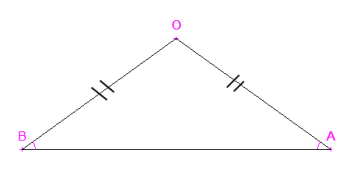
Isosceles triangle: 
This triangle possesses two sides of same length and two identical angles.
Equilateral triangle: 
This triangle has three identical angles of 45 degrees and each side has the same length.

The right-angled triangle :

Another type of triangle is the right-angled triangle, which has a right-angle, in other words, an angle measuring 90 degrees. This triangle has led to theorems such as the Pythagoras theorem or the trigonometry equality.
Pythagoras' theorem --- In a right-angled triangle plan, the square of the length of the hypotenuse opposite side to the right angle is equal to the sum of the squares of the lengthes of the sides of the right angle.
In a triangle ABC right-angled in C, AB being the hypotenuse, where AB = c, AC = b, BC = a, :
BC² + AC² = AB²
The Pythagoras' theorem allows to calculate the length of one of the sides of a right-angled triangle if we know the two others.
Example : a = 3, b = 5.
a² + b² = 3² + 5² = 9 + 25 = 36 = c²
so : c = 5.
Subscribe to:
Comments (Atom)